

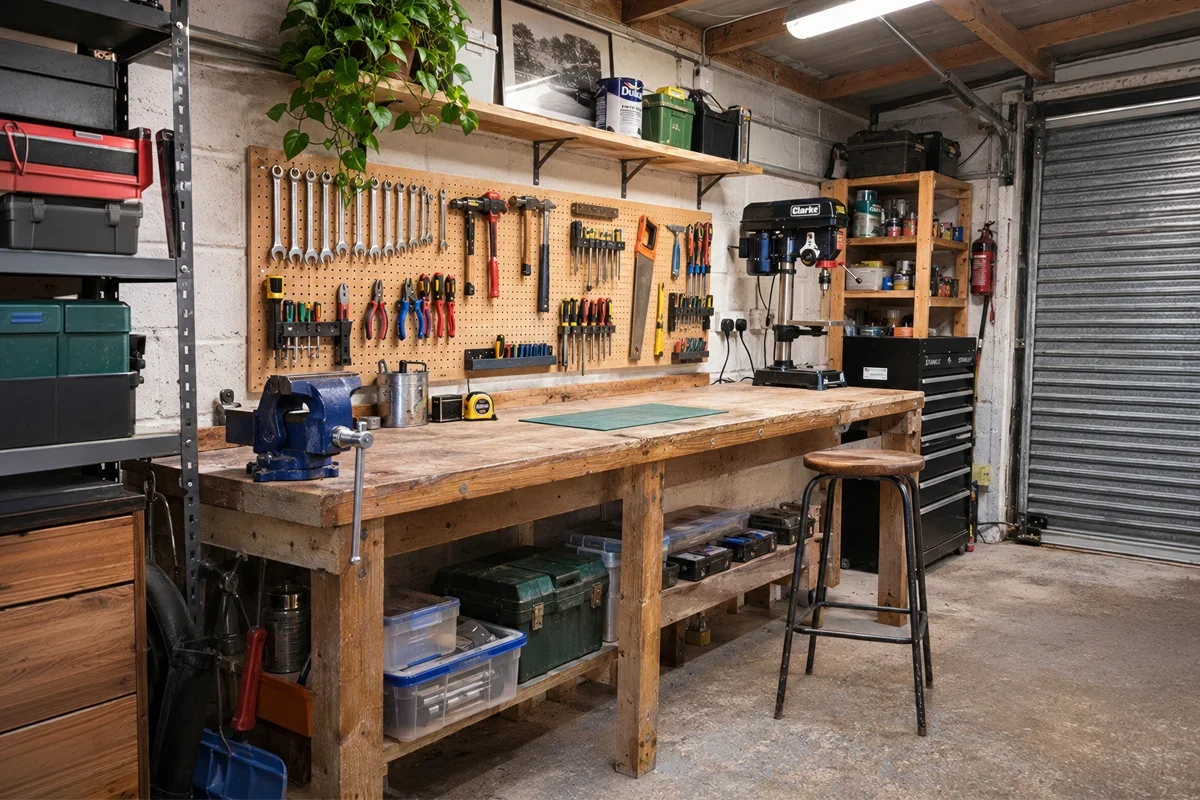
As winter sets in across the UK, spending time in a cold garage or workshop becomes a lot less appealing. Whether you're restoring a car, working on a woodworking project or carrying out repairs, trying to get things done when your hands are freezing isn't much fun.
Unlike our homes, most garages and workshops aren't built with comfort in mind. Concrete floors, metal roofs, draughty doors and poor insulation make them difficult to keep warm. Even with a heater running, you might find that the temperature drops almost as soon as you turn it off.
Finding the best way to heat a workshop can be tricky. Electric heaters are convenient, but running them for hours can become expensive. Installing a permanent heating system may be more than you need, particularly if you only use your workshop at weekends or in the evenings.
Fortunately, there are several ways to make a cold workshop more comfortable without committing to an expensive heating installation.
In this guide, we'll look at what makes workshops so difficult to heat, how to reduce heat loss, and which heating methods are worth considering. We'll also explore how portable diesel heaters can provide warmth in garages, sheds and workshops during the colder months.
Why Are Workshops and Garages So Difficult to Heat?
The main problem with heating a workshop is often the building itself.
Most domestic garages and garden workshops were designed to protect vehicles, tools and equipment from the weather. Keeping people comfortable wasn't always part of the plan.
A typical garage might have single-skin brick walls, an uninsulated concrete floor and a large metal door. Garden workshops can have similar problems, particularly those built from timber or metal panels.
During winter, these surfaces become cold and allow heat to escape. Warm air can also find its way out through gaps around doors, windows and roof panels.
The size of the building plays an important role too. A workshop with a high ceiling contains a large amount of air that needs warming. As hot air rises, the space around the ceiling can become warmer than the area where you're actually working.
This is particularly noticeable when using a fan heater in a tall garage. You might have warm air collecting overhead while your feet are still cold.
Large doors create another challenge. Opening a garage door to move a vehicle or bring materials inside can quickly replace warm air with cold air from outside. Your heater then has to work to bring the temperature back up.
All of these factors affect how much energy you need to keep the space comfortable.
The first step towards cheaper workshop heating is understanding where your heat is going. A more powerful heater may help, but reducing heat loss can be just as important.
How to Keep a Workshop Warm Without Wasting Energy
Before spending money on a new workshop heater, it's worth looking at a few simple improvements.
A heater will always have an easier job in a space that holds onto its warmth. You don't necessarily need to fully insulate your garage to see a difference.
Reduce Draughts Around Doors and Windows
Garage doors are one of the most common places for cold air to enter a workshop.
Older up-and-over doors often have gaps around the sides and bottom. Even when the door is closed, cold air can pass through these openings, particularly during windy weather.
Fitting suitable rubber seals or draught strips can help reduce unwanted airflow. The same applies to gaps around windows and external doors.
If your workshop has a timber door, check whether it closes tightly against the frame. Small gaps can be enough to create a noticeable cold draught around your feet.
Pay attention to the areas where you spend the most time. A draught blowing directly across your workbench can make the room feel colder than the thermometer suggests.
It's important to leave any required ventilation openings clear, especially if you're using machinery, chemicals or equipment that needs fresh air.
Consider Insulating the Roof and Walls
If you use your workshop regularly, insulation could be worth the investment.
Heat can escape through uninsulated roofs and walls, particularly in lightweight buildings. Adding suitable insulation slows this process and helps the building hold a more stable temperature.
For a timber garden workshop, this might mean insulating between the wall studs and fitting an internal lining. A brick garage may need a different approach, depending on its construction and the amount of space available.
The roof is also worth examining. Warm air naturally rises, and an uninsulated roof can allow a significant amount of heat to escape.
Insulation needs to be installed correctly, with suitable moisture control and fire safety measures. Poor installation can trap moisture and cause problems with damp or timber decay.
If a full insulation project isn't practical, smaller improvements around doors and the main working area can still help.
Focus on the Area Where You Actually Work
You don't always need to heat the entire workshop to make it more comfortable.
Someone restoring a car might spend several hours working in one part of a garage. A woodworker may spend most of their time at a single bench.
In these situations, directing warmth towards the working area can make more sense than trying to maintain the same temperature throughout the building.
Portable heaters are useful here because you can choose where the warmth is delivered. Some provide direct radiant heat, while others circulate warm air.
The best approach depends on the type of work you're doing, how much you move around and whether your equipment needs a stable room temperature.
Choosing the Best Heater for a Workshop
There are several ways to heat a garage or workshop in winter, and each has its own advantages.
The cheapest heater to buy won't necessarily be the cheapest to operate. Equally, a heating system with low running costs may have a high installation price.
Consider how often you'll use your workshop before deciding what makes the most sense.
Electric Fan Heaters
Electric fan heaters are one of the easiest workshop heating options to get started with, they're widely available, usually require no installation and can begin circulating warm air shortly after being switched on.
For a small, reasonably insulated garage, an electric fan heater may provide enough warmth for occasional work. The main consideration is electricity consumption.
A 2 kW electric heater running continuously at full power uses 2 kilowatt-hours (kWh) of electricity every hour. If you use it for four hours, that adds up to 8 kWh.
At an example electricity rate of 25p per kWh, that would cost £2 for the four-hour session. Your actual cost will depend on your tariff and how long the heater operates at full power, electric fan heaters are also affected by draughts and poor insulation. If warm air escapes quickly, the heater may need to operate for longer to maintain a comfortable temperature.
That might be reasonable for an occasional afternoon, but the cost can build up if you work in your garage every day.
Infrared Workshop Heaters
Infrared heaters work differently from ordinary fan heaters, Instead of relying mainly on warming the surrounding air, they transfer heat directly to people and surfaces.
This makes them useful in workshops where you're working in one place for extended periods.
For example, an infrared heater positioned to warm a workbench area can help keep you comfortable without needing to warm every part of a large garage.
However, the heating effect is strongest in the area directly exposed to the heater, if you frequently move around your workshop, you may find that some areas remain cold. Tools, machinery and materials outside the heated area may also stay at a lower temperature. Infrared heating can be a practical choice for fixed workstations, but it won't suit every workshop.
Diesel Workshop Heaters
Diesel air heaters are another option worth considering, particularly for workshops where portability and flexible heating are important. These heaters burn diesel fuel to generate heat. A fan moves air across a heat exchanger, allowing the heater to deliver warm air separately from the combustion exhaust.
Diesel heaters still require electricity to operate their fans, fuel pumps and electronic controls. However, the main heating energy comes from the diesel fuel rather than the electrical supply this can make them useful in locations where a suitable low-voltage electrical supply is available but a high-powered mains heater isn't practical.
Some diesel heating systems are designed for permanent installation, while others are portable and can be moved between suitable locations. The way the heater is installed matters. Combustion exhausts must be kept out of occupied spaces, and each model has its own requirements for ventilation, positioning and safe use.
An outdoor diesel heater with warm-air ducting can be a useful option for a garage or workshop, as it allows the heating unit to remain outside while warm air is directed indoors.
Air-to-Air Heat Pumps
If you use your workshop every day, a fixed air-to-air heat pump may also be worth considering. These systems use electricity to move heat from outside into the building. Under suitable conditions, they can deliver several units of heat for each unit of electricity consumed.
This can make them more economical to run than ordinary electric resistance heaters, especially in an insulated workshop used for long periods. However, installation costs are higher, and the building needs to be suitable for a permanent system. Heat pump performance also changes with outdoor temperature.
For someone who uses a garage once or twice a week, a fixed heating installation may be difficult to justify. For a workshop used throughout the working week, the longer-term running costs could make it worth investigating.
How Much Does It Cost to Heat a Workshop in Winter?
Heating costs depend on more than the type of heater you choose, a small, insulated workshop might only need modest heating once it reaches a comfortable temperature. A larger garage with gaps around the doors may need a heater running continuously to replace escaping warmth.
The number of hours you spend in the workshop is important too If you work there for two hours on a Sunday, your heating requirements will be very different from someone using the same building for eight hours every weekday.
For electric heaters, the calculation is fairly simple. Multiply the heater's electrical power in kilowatts by the hours it operates, then multiply the result by your electricity rate.
For diesel heaters, you'll need to know the amount of fuel consumed at your chosen setting and the price you pay per litre. You'll also need to allow for the electricity used during operation.
Fuel consumption varies with the heater's output, temperature settings and operating conditions. It's important to compare the heat delivered and the total cost of operating each system. A 5 kW diesel heater's heating output, for example, should not be confused with its electrical power consumption.
Rather than choosing a heater based on fuel prices alone, think about the whole setup. A portable heater may be more convenient if you use several workspaces, while a fixed heating system may be better suited to a workshop used every day.
Heating Your Workshop with the HEATFLOW Portable Diesel Heater
For workshops where a portable heating system makes sense, the HEATFLOW Portable Diesel Heater from Totalcool offers a way to direct warm air into your workspace while keeping the heater outside.
Designed and built in Britain, HEATFLOW provides up to 5 kW of heating output and features an IP33-rated enclosure developed for outdoor use.
The idea behind HEATFLOW is straightforward. The heater is positioned outdoors in a suitable location, and warm air is carried through ducting into the space you want to heat. This arrangement keeps the diesel combustion unit and its exhaust outdoors, away from the occupied workspace.
For a garage or garden workshop, it means you can introduce a source of warm air without having to position the diesel heater itself inside the building.
How Does HEATFLOW Work in a Garage or Workshop?
Imagine you're spending a Saturday afternoon working on your car in a detached garage.
The outside temperature is low, and the garage has no permanent heating. The concrete floor and metal door have been cold all night, so the space isn't particularly welcoming.
With a suitable setup, HEATFLOW can be positioned outside the garage while its warm-air ducting is directed through an appropriate opening.
Once the heater is running, warm air is delivered into the garage, helping to make the working area more comfortable.
The supplied 2.5-metre warm-air duct gives you flexibility when choosing a suitable position for the heater. The opening and duct route must be safe, with no sharp edges, crushing points or contact with materials that could be damaged by heat.
Because HEATFLOW has adjustable heating controls, you can change the settings according to the conditions and the amount of warmth you need.
It's worth remembering that the size and insulation of the garage will affect the results. A 5 kW heater may provide useful warmth in a smaller workspace but could struggle to maintain a comfortable temperature in a large, draughty building.
HEATFLOW is designed for outdoor operation, so the heater itself should remain outside in accordance with the product instructions.
Built for Outdoor Heating
One of HEATFLOW's main features is its IP33-rated enclosure. The rating provides a defined level of protection against solid objects and water spray. This makes the heater suitable for outdoor use under the conditions described in its instructions.
For workshop owners, this allows the heater to be positioned outside while warm air is delivered indoors.
The powder-coated steel enclosure is designed to protect the internal components, while the reinforced carry handle makes the heater easier to transport between locations.
HEATFLOW weighs approximately 10 kg when empty, so it can be moved between suitable workspaces once it has been switched off and allowed to cool.
The exhaust outlet also has a protective cover. However, the exhaust and surrounding components can still become hot during use.
The heater must be placed securely, with suitable clearance around the air intake, outlet and exhaust. Its exhaust must be kept away from openings where fumes could enter a building.
Flexible Power Options for Different Workshops
Although HEATFLOW uses diesel as its heating fuel, it still requires electrical power to operate.
The unit supports suitable 12 V DC supplies, as well as mains electricity using the supplied power adaptor, useful for workshops where access to electrical sockets is limited.
For example, a garden workshop with no mains connection may be able to use a compatible portable power station or battery, provided it can meet the heater's electrical requirements. It's important to check the available power before choosing a battery. Diesel heaters generally require more electrical power during startup and shutdown than during steady operation.
HEATFLOW must be allowed to complete its normal shutdown cycle, so the electrical supply shouldn't be disconnected while the heater is cooling down.
Heating Controls That Suit Your Working Day
A workshop doesn't always need the same amount of heat throughout the day. When you first arrive, the building may be very cold. After you've been working for a while and the space has warmed up, you may want to adjust the heating level.
HEATFLOW includes a wired controller and Bluetooth app compatibility, allowing you to manage its settings without having to move every time you want to make an adjustment.
You can select heating settings, monitor operating information and use the available timer functions.
This is particularly useful when you're working on a project that requires concentration. Once you've set up the heater safely, you can manage your comfort from inside the workspace.
Explore the HEATFLOW Portable Diesel Heater
Can You Heat an Uninsulated Garage with a Diesel Heater?
An uninsulated garage is one of the more challenging spaces to heat, particularly during a cold UK winter.
Concrete floors absorb heat, metal doors can become very cold, and gaps around the building allow warm air to escape. A diesel heater can provide useful warmth in this type of environment, but the results depend on the building.
Consider two garages of the same size. One has an insulated roof, a sealed door and double-glazed windows. The other has bare walls, a thin metal roof and several large gaps around its doors. Even if both garages use the same heater, the first will generally be easier to keep warm.
In an uninsulated garage, it may be more practical to focus on heating the area where you're working rather than attempting to raise the temperature of the whole building. Warm-air ducting can help direct heat towards a suitable working area. However, the duct must remain clear and correctly positioned to avoid restricting airflow or creating a hazard.
For anyone planning to spend a lot of time in the garage, combining suitable heating with draught reduction and insulation improvements is likely to provide better results than simply buying a larger heater.
It's also worth thinking about the temperature needed for your work. Some paints, adhesives, finishes and other materials have minimum application or curing temperatures. Local warmth around a person may not be enough to bring the materials or room up to the required temperature.
Always follow the relevant product instructions if your work depends on a specific temperature.
Does Heating a Workshop Help Prevent Condensation?
Cold workshops can suffer from condensation, particularly during autumn and winter. You might notice moisture forming on metal tools, window glass, machinery or other cold surfaces. Over time, this can contribute to corrosion and damage to stored equipment.
Condensation forms when moist air comes into contact with a surface cold enough for water vapour to turn into liquid water. Heating can help by raising the temperature of the air and surrounding surfaces, but it doesn't remove the moisture already present.
This is an important point for workshop owners. A warmer garage can still suffer from condensation if humidity remains high or moisture has nowhere to escape. Wet vehicles, damp clothing, water leaks and moisture entering through the building can all contribute to the problem.
Improving ventilation where appropriate, dealing with leaks and reducing moisture sources are sensible steps. In some workshops, a dehumidifier may also be useful.
It's worth keeping an eye on humidity with a simple digital thermometer and hygrometer. These inexpensive devices can help you understand how the conditions change throughout the day.
If you're storing valuable tools or equipment, managing moisture is just as important as choosing the right heater.
How to Heat a Workshop Safely in Winter
Any heating equipment needs to be used carefully in a workshop.
Garages and sheds often contain fuel, paint, solvents, timber, cardboard and other combustible materials. It's important to keep heaters and hot components away from anything that is sensitive to heat.
Workshops may also contain fumes from vehicles, chemicals or machinery. Good ventilation is essential, whatever heating system you choose.
With diesel heating equipment, particular attention must be paid to combustion exhaust gases, which can contain carbon monoxide. The HEATFLOW's control unit that is designed to be kept inside has a built-in carbon monoxide detector for extra peace of mind.
HEATFLOW is intended to operate outdoors, with warm-air ducting delivering heat into the workshop. The exhaust must stay outside and be positioned so fumes cannot be drawn into doors, windows, vents or other openings.
The heater should be placed on a stable surface with the clearances required by its instructions. Never position it where flammable vapours may be present, and avoid routing ducting through areas where it could become trapped, crushed or damaged.
A suitable carbon monoxide alarm inside the occupied space is an important additional precaution. It doesn't replace correct positioning, ventilation or following the manufacturer's instructions.
For commercial workshops, employers also need to consider workplace temperature requirements.
The UK's Health and Safety Executive advises that indoor workrooms should normally be kept at a minimum of 16°C, or 13°C where much of the work involves rigorous physical effort. Exceptions apply where maintaining these temperatures is impractical, and employers must assess what is reasonable for the workplace.
You can find more information in the HSE's workplace temperature guidance.
Frequently Asked Questions About Workshop Heating
What Is the Cheapest Way to Heat a Workshop in Winter?
The cheapest option depends on the size of the workshop, how well it's insulated and how often you use it.
If you only spend a few hours there each week, a portable heater may be more practical than installing a permanent system.
If you use your workshop every day, improving insulation and looking at efficient fixed heating could make more sense over time.
Before investing in a heater, check for draughts and obvious sources of heat loss. Keeping more of the warmth inside can reduce the energy needed, whatever heating method you choose.
Are Diesel Heaters Suitable for Garages?
Diesel heaters can be suitable for garage heating when correctly selected, installed and operated.
There are different types of diesel heater, and their ventilation and installation requirements vary.
HEATFLOW is designed to operate outdoors, directing warm air into a garage or workshop through ducting. This keeps the combustion unit outside the occupied space.
Always follow the manufacturer's instructions and make sure exhaust fumes cannot enter the building.
Is a 5 kW Diesel Heater Enough for a Garage?
A 5 kW heater would be suitable for some garages and small workshops, but heating output alone doesn't tell you how warm the room will become.
The required heating capacity depends on the building's dimensions, insulation, air leakage and the temperature you want to maintain.
A small, well-insulated garage will usually need less heating than a large, uninsulated workshop.
If you need to maintain a specific temperature throughout the building, particularly for commercial work, a proper heat-loss calculation is the most reliable way to assess the heating requirement.
Is Diesel Heating Cheaper Than Electric Heating?
Diesel heating can be an option worth comparing with electric heating, but neither is guaranteed to be cheaper in every situation.
Diesel costs depend on fuel consumption and the price per litre. Electric heating costs depend on power consumption and your electricity tariff.
The type of electric system matters too. An ordinary resistance heater and a heat pump can have very different running costs.
When comparing heaters, consider their heating output, energy consumption, purchase price and the number of hours you'll use them.
Can You Heat a Workshop Without Mains Electricity?
Yes, there are heating options for workshops without a mains electricity connection.
Some portable diesel heaters, including HEATFLOW, can operate from suitable 12 V DC electrical supplies.
This means a compatible battery or portable power station may be used, provided it can supply enough power during startup, normal running and shutdown.
You'll need to check your power source's capacity and output before use.
Finding the Right Heating Setup for Your Workshop
There's no single heating solution that works for every garage, shed or workshop.
A small, insulated woodworking shed may be comfortable with a modest electric heater. A garage used occasionally for car maintenance might benefit from a portable heating system that can be set up when needed.
Larger workshops used every day may be better suited to a permanent, properly sized heating system.
The important thing is to consider how you actually use your space.
Think about where you spend your time, how much warmth you need, how quickly the building loses heat and what you're prepared to spend on running costs.
Even simple changes, such as sealing draughts and insulating a garage door, can help improve comfort.
If you're looking for a portable diesel heating option, HEATFLOW provides up to 5 kW of adjustable heating output and is designed to operate outdoors while delivering warm air into a suitable indoor workspace.
With the right heating arrangement, cold winter weather doesn't have to bring your workshop projects to a halt.
Keep your HEATFLOW outside. Feel the warmth inside.

